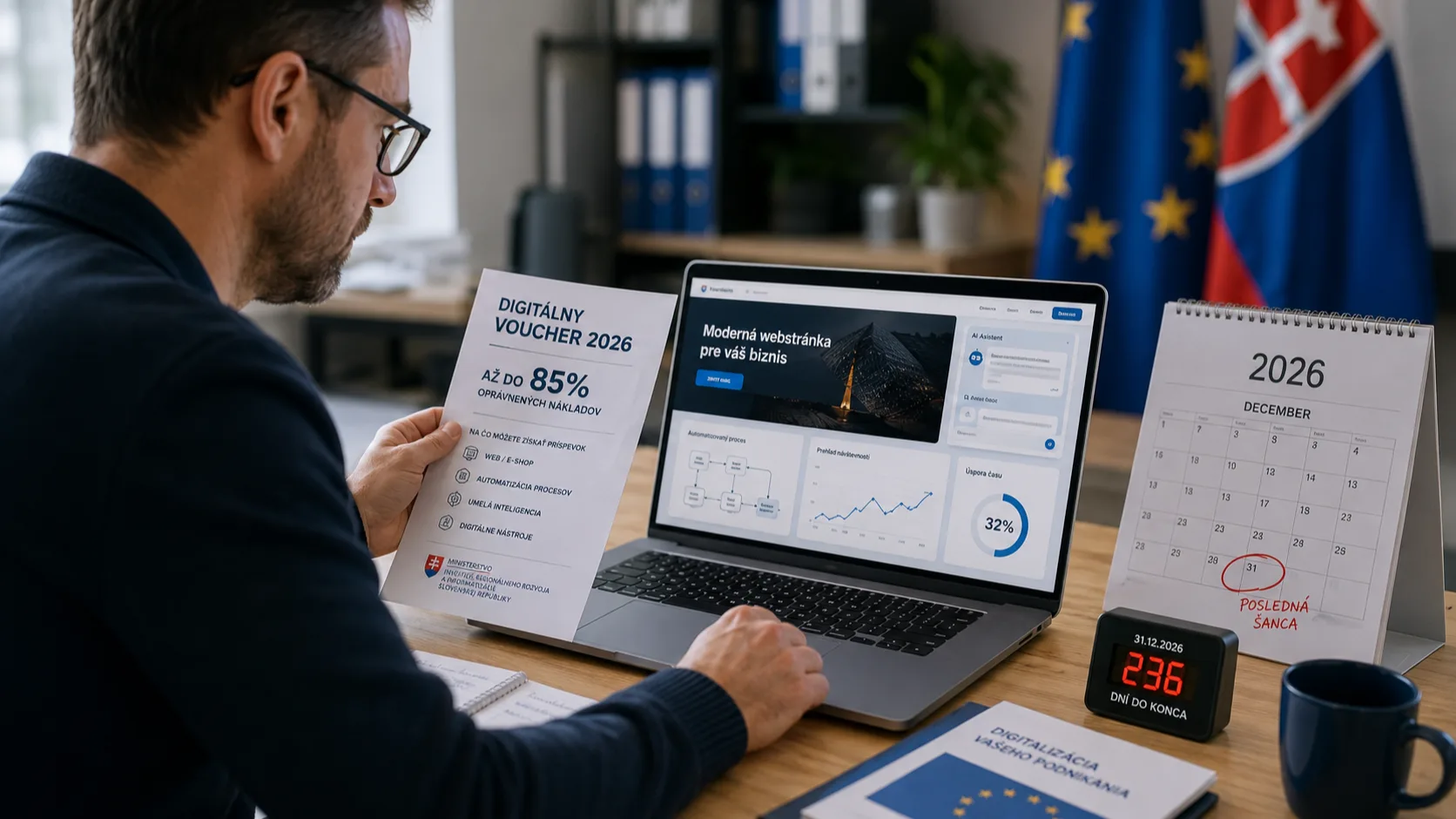
'The state will cover up to 85% of your website and automation.' Partly true: Slovakia set aside 20 million euro from the Recovery Plan for digital and innovation vouchers, covering up to 85% of eligible costs, capped at 15,000 euro per company. The catch is the words 'up to', and the fact that 2026 is a finish line for this money, not a start.
'Can we get a grant for this?' I hear that on almost every larger project. I am Tair Khamitov, and at DevNova we build websites, e-shops and automation for small companies. Instead of another optimistic brochure, I went through the SIEA voucher conditions and what is actually happening with EU digitalization money right now. This is what came out of it, no rose-tinted glasses.
Contents
1. The hype: the state will pay for your site
Open LinkedIn, or listen to any seller of grant services, and you hear the same loop: 'the state will cover your website', 'there are millions for digitalization, you just have to ask', 'let the EU funds pay for it'. It sounds as if a pile of money is lying somewhere and you only need to pick it up.
Part of that is true. Money for business digitalization does exist, and some companies genuinely drew on it. The problem is what the sentence hides: how much exactly, under what conditions, until when, and whether it applies to your type of project at all. The marketing shorthand 'the state pays 85%' quietly drops three of those four things.
'The state pays 85%' sounds like a guarantee. It is a ceiling, not a promise.
2. What the digital and innovation vouchers really are
Let us go to the numbers from the primary source. The Ministry of Economy of the Slovak Republic and SIEA launched two instruments from the Recovery Plan: digital and innovation vouchers. Twenty million euro in total (roughly 12.2 million for digital and 7.6 million for innovation), covering up to 85% of eligible costs, with a cap of 15,000 euro per company.
A digital voucher can be used for things like automation, optimizing internal processes, digitalizing manufacturing or finance, cybersecurity, or deploying AI. So yes, exactly the kind of project a small business runs when it wants a website wired to its stock system, or a chatbot for support.
And now the important word. It is not '85% always'. It is 'UP TO 85%'. What you actually get depends on what is recognized as an eligible cost, on the specific call, and on whether the money reaches you before it runs out. The gap between 'up to 85%' and '85%' is exactly the gap you will not find in the LinkedIn post.
| Programme | Run by | Budget | Covers | 2026 status |
|---|---|---|---|---|
| Digital and innovation vouchers | SIEA / Government Office | 20M EUR | up to 85%, max 15,000 EUR | digital call V04 closed 2023; innovation V03 open |
| Digital challenge (R&D) | MIRRI | ~58M EUR | up to 60% | of 80 quality projects, ~44 funded |
| Innovation vouchers 2026 | SIEA | from Recovery Plan | per call | new narrow industrial calls (robotics, dual-use tech) |
The figures in the table come from the official SIEA, Ministry of Economy and MIRRI pages (links below), as of July 2026. The exact conditions and call status change, so always verify them with SIEA before you apply.
The gap between 'up to 85%' and '85%' is exactly the one a grant seller will not mention.
3. A parallel scandal that shows the risk
So this is not just theory, look at what happened one floor up. A completely different programme, the so-called digital challenge for digital research and development, run by MIRRI rather than SIEA, had a budget on the order of 58 million euro. It received 162 applications, and 80 quality projects passed expert evaluation.
And how many of those 80 quality projects actually get the money? The minimum the European Commission required as a Recovery Plan milestone: 44. The rest, even though they passed evaluation, the ministry let fall after pressure and public questioning of the call. The ministry itself writes that this was not due to a lack of funds, but due to 'pressure that shifted this call from the professional into the political space'. Media described it as a wasted opportunity for Slovak research.
Let me say it BLUNTLY: this is not the same programme as the vouchers from the previous section. The digital challenge was digital R&D, a different ministry, a different budget, different rules (it covered up to 60%, not 85%). Do not read it as proof that the vouchers will be cut too. Read it as a demonstration of what happens to state digitalization funding when a deadline squeeze meets politics.
Eighty quality projects passed evaluation. About half get paid. Not for lack of money, but for pressure.
4. Why 2026 is the finish line for this money
Here is the context most grant articles skip. Under the official rules, Slovakia has to draw down the entire Recovery Plan and finish implementation by the end of 2026, with the key milestones running throughout the year. It is not a bottomless well. It is a fund worth 6.4 billion euro with a hard end date.
About a fifth of the whole Recovery Plan allocation goes to digital transformation, and the drawdown is tied to milestones that Slovakia reports to the European Commission twice a year. The money flows only once those milestones are met. That is why, in the programme's final year, decisions are made fast and defensively: the goal is to report a milestone as met, not to maximize the number of supported companies.
In practice that means this: in 2026 the authorities are under pressure to spend and report, not to launch relaxed new rounds. Milestones get rewritten (most recently at the end of 2025), programmes get simplified, some calls close. That is exactly why the digital challenge from the previous section ended the way it did: the ministry needed to hit a milestone, not to please 80 applicants.
For a small business the conclusion is simple. If you count on the state comfortably reimbursing your website in 2026, you are building your plan on the least certain part of the budget. The money may be there, but the window is narrow and the conditions shift as you go.
The Recovery Plan is not a well. It is a fund with an end date, and that date is 2026.
5. Who can apply and what counts as eligible
Simply, without the legal jargon. The digital and innovation vouchers targeted businesses, typically small and medium ones (each call sets the exact size definition). An eligible cost is what the call lists. For a digital voucher that means automation, process digitalization, cybersecurity, AI. Not just anything you happen to have an invoice for.
An important reality check for the state of play in 2026: the original digital voucher call (code 09I02-03-V04) closed back at the end of 2023. The innovation voucher call was open, but it gathered over a thousand applications, so demand far outstripped supply. SIEA has since launched new calls for innovation vouchers, but they are narrowly industrial (robotics and automation in manufacturing from January 2026, progressive and dual-use technologies from April 2026), not a universal 'for any website'.
Translated into plain speech: 'the state will pay for your website' fit better as a sentence in 2023 than it does today. In 2026 there are targeted calls for specific sectors rather than one big voucher for everyone to build any website. So there is no universal 'yes, apply'. You have to look at the current call and whether your project fits it.
'The state will pay for your website' was a more accurate sentence in 2023 than in 2026.
6. A quick self-check: is it worth applying?
Before you pay anyone to 'sort out a grant', run three questions. It takes five minutes and can save you hundreds of euro in advice about something you will not reach anyway.
- 1. Does the project type fit? An open call lists its eligible activities. If your plan (website, e-shop, chatbot, automation) is not on it, the grant is not for you, not even at 85%.
- 2. Can you carry the co-financing and the cashflow? A voucher typically works as a reimbursement. You pay first, then part comes back. You need the full amount up front, not just your own share of it.
- 3. Is your project ready? Calls have deadlines and they run out. Whoever shows up with a finished brief and a price quote applies quickly and well. Whoever starts designing a website only after a call opens usually misses it.
A worked example, to make the numbers concrete. An e-shop for 2,000 euro, the whole of it recognized as an eligible cost, a voucher at 85%: the state reimburses 1,700, you top up 300. Nice, but only if (a) you get the voucher, (b) the whole cost is eligible, and (c) you have that 2,000 out of your own pocket first. Three 'ifs'. And if only half of that 2,000 euro were eligible, the refund drops to 850 euro and you top up 1,150, which is why it pays to know in advance what the call recognizes rather than hope everything goes through. That is why I always treat a grant as a bonus, not as the base of a budget.
Treat a grant as a bonus, not as the base of your budget.
7. How we handle this at DevNova
We are not a grant agency, and we do not promise to 'sort out EU funds' for you. What we can offer is the opposite of that uncertainty: a fixed price you know up front, and a project we build and hand over in 11 days. When an open call happens to fit your type of plan, a ready brief and price quote give you the head start to apply well and on time, instead of starting from scratch once the clock is already running.
Concretely. We build websites from 349 euro (one-time, three plans). AI automation and chatbots from 120 euro setup plus 15 to 80 euro a month, more complex integrations from 480 euro. We add e-commerce modules one at a time, from 480 euro (a cart) to 3,600 euro and up (full checkout with stock and invoicing). The whole price list is public, no 'contact us for a quote'.
Why I mention this next to grants: many businesses postpone a website precisely because they are waiting for a grant that may never come. Yet the real cost of the project is often lower than the sum they imagine the state will 'save' them. While you wait for a call, your competitor is already selling. How this fits into gradual digitalization is laid out in our guide to digitalizing a small business, and what a website really costs without a grant is in our pricing breakdown.
While you wait for a grant that may never come, your competitor is already selling.
Frequently asked questions (FAQ)
What exactly do the digital and innovation vouchers cover? They are two Recovery Plan instruments (20 million euro together) that cover up to 85% of eligible digitalization costs, capped at 15,000 euro per company. The digital voucher targets automation, process digitalization, cybersecurity and AI. The exact activities are listed by the specific SIEA call.
What percentage of a website or automation does the state really cover? The ceiling is up to 85% of eligible costs, but 'up to' is not 'always'. The real amount depends on what the call recognizes as an eligible cost and whether the funds reach you. Count on a portion of the cost rather than an automatic 85%.
Why did the digital challenge shrink from 80 projects to 44? It was a different programme (digital R&D under MIRRI, not a SIEA voucher). Of 162 applications, 80 quality projects passed, but under pressure the ministry funded only the minimum of 44 that the European Commission required as a Recovery Plan milestone. The reason was not a lack of money, but the pressure around the call.
Does that mean the website vouchers will get less money too? It does not prove it directly, it is a different programme with different rules. But it shows the risk: in 2026, as the Recovery Plan closes, programmes are under pressure from deadlines and politics. So approach state money with care and do not build your whole budget on it.
Who can apply for a digital voucher? They targeted businesses, typically small and medium ones; each call sets the exact size definition and sector. The original digital voucher call closed at the end of 2023; in 2026 the open ones are more targeted industrial vouchers (robotics, dual-use technologies). Verify the current status directly with SIEA.
How long does approval take and when can the project start? It depends on the call, but count in weeks to months, and on a reimbursement model: you pay first, then part comes back. That is why it pays to have the project (a brief and a price quote) ready in advance, so you can apply the moment a call opens.
When is the next round and how do you prepare for it now? SIEA publishes exact deadlines on a rolling basis (in 2026 it added vouchers for robotics from January and for dual-use technologies from April). Prepare by having a clear plan, a budget and a supplier. We can deliver the brief and the price quote you apply with, so you apply well. Send us a brief or write to b2b@devnova.eu.
About the author
Does a grant actually fit your specific project, or is it just another optimistic headline? With subsidies and calls that is the only question that really matters. Tair Khamitov runs the Bratislava studio DevNova. We build websites, e-shops and AI automation at a fixed price with delivery in 11 days; for larger jobs Tair brings the right people onto a project — a designer, a content writer, a developer — depending on what the work needs. He is not a tax or legal adviser; for a specific application, verify the conditions directly with SIEA. Contact: b2b@devnova.eu.